Terry Smith and Fundsmith: farewell to "do nothing"
"Buy good companies, don't overpay, do nothing." With that three-step rule Terry Smith became Britain's best-known fund manager and Fundsmith the country's largest active retail fund. In 2026, Smith dropped the third part. A look at the man, the strategy and a portfolio in transition.
The manager: analyst, provocateur, entrepreneur
Terry Smith was born in London in 1953. He studied history and started his career at Barclays in 1974. He made his name as a bank analyst – and became notorious for his book Accounting for Growth (1992), which showed how listed companies dressed up their profits with accounting tricks. His employer at the time parted ways with him after publication; the book became a classic.
He later ran the broker Collins Stewart and the inter-dealer broker Tullett Prebon. In 2010 he founded Fundsmith and launched Fundsmith Equity – with a deliberately short, understandable rulebook and low costs compared with many rivals.
Private side and personality
Smith is known for his sharp tongue and strong opinions; his annual shareholder letters and meetings are required reading in the industry. He has lived outside the UK for years and regularly speaks out on accounting, corporate governance and index funds – often taking aim at management teams, analysts and market fads.
Praise and criticism
Praise: From 2010 to around 2021, Fundsmith Equity delivered an outstanding record and clearly beat the global equity index. Since launch, according to industry data, the fund is still ahead of the MSCI World. Smith's discipline, transparency and plain language have brought quality investing to many private investors.
Criticism: Since 2021 things have gone badly. In 2025 the fund trailed the index for the fifth calendar year in a row, returning less than one percent. Costly mistakes such as Novo Nordisk cost around three percentage points in 2025 alone. In the first half of 2026 the fund lost 2.9% while the MSCI World gained 11.2%. Smith partly blamed index concentration, passive flows and the weak dollar – critics see excuses. Heavy outflows add to the pressure.
Strategy: quality – and now momentum
The core remains: Fundsmith buys companies with high returns on capital, stable margins, little debt and organic growth. What's new is the execution: Smith said he would pay more attention to earnings momentum and exit positions that aren't working more quickly. The result was turnover of 51.8% of the portfolio in the first half of 2026 – a record for a fund whose motto long was "do nothing".
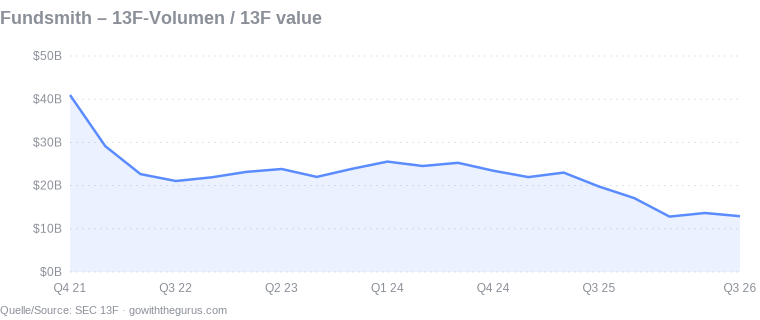
The decline in 13F value reflects both weaker prices and outflows.
The portfolio in Q3 2026
As of 30 September 2026, Fundsmith reported U.S. positions worth about US$12.9bn (previous quarter: US$13.6bn). European holdings such as L'Oréal do not appear in the 13F filing.
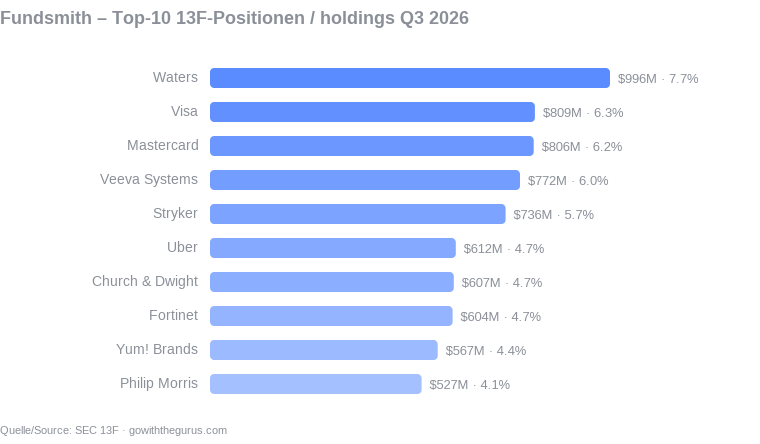
The largest positions: Waters (7.7%), Visa (6.3%), Mastercard (6.2%), Veeva Systems (6.0%), Stryker (5.7%), Uber (4.7%), Church & Dwight (4.7%), Fortinet (4.7%), Yum! Brands (4.4%) and Philip Morris (4.1%). Notably, Uber, AppLovin, GE Vernova and Netflix now sit in a portfolio few would have associated with them two years ago.
What changed
The overhaul continued in Q3 – forcefully:
- Sharply increased: Veeva Systems (share count +231%, now top 4), Yum! Brands (+648%), TJX (+44%), Mastercard (+17%), Visa (+11%).
- Cut significantly: Microsoft (–51%), Marriott (–47%), Alphabet (–45%), Meta (–43%), Procter & Gamble (–36%), IDEXX (–30%), ADP (–29%) and GE Vernova (–57%, bought only in spring).
- New: small positions in Rambus and Credo Technology.
- Sold: Clorox.
The direction is striking: away from large tech platforms and classic consumer staples, towards payment networks, specialist software for the life-sciences industry and restaurant franchising.
Our take
Fundsmith shows how hard it is even for successful quality investors to beat a market driven by a handful of mega-caps. Smith's change of course is honest – he admits mistakes – but it carries a new risk: more activity does not automatically mean better results. The next few quarters will show whether the new approach works.
See all positions and changes on the Fundsmith fund page.
Note: 13F filings only show U.S. long positions at quarter-end and are published up to 45 days later. Past performance is not a reliable indicator of future results. This article is not investment advice.