Li Lu and Himalaya Capital: Munger's confidant bets on PDD and Alphabet
When Charlie Munger called someone the only outside money manager he ever trusted with his family's capital, the industry paid attention. That someone is Li Lu, founder of Himalaya Capital. His portfolio is one of the most concentrated we track in 13F filings – and one of the most instructive.
The manager: from the Tangshan earthquake to Columbia University
Li Lu was born in China in 1966 and grew up in difficult circumstances, spending part of his childhood with foster families. As a boy he survived the devastating 1976 Tangshan earthquake. He later studied in Nanjing and, in 1989, became known as one of the student leaders of the Tiananmen Square protests. After the crackdown he fled abroad and made his way to the United States.
At Columbia University he earned a BA, a JD and an MBA at the same time – a rare triple degree. During those years he attended a lecture by Warren Buffett that, by his own account, convinced him immediately: treat shares as pieces of real businesses, not as ticker symbols. He started investing while still a student.
After a short stint in investment banking at Donaldson, Lufkin & Jenrette he founded Himalaya Capital in 1997. His reputation took off after he met Charlie Munger in 2003: Munger entrusted part of his family's wealth to Himalaya and liked to call Li Lu the "Chinese Warren Buffett". Li Lu was also behind Berkshire Hathaway's well-known investment in Chinese carmaker BYD.
Private side and personality
Li Lu keeps a low profile, rarely gives interviews and lives his philosophy privately too: long holding periods, little noise. He supports education and wrote a widely discussed book on civilisation, modernisation and value investing in China. To many he is the bridge between the Buffett-Munger school and a new generation of Chinese investors. In early October 2026 he was the keynote guest at Columbia Business School's long-running Graham & Dodd Luncheon.
Praise and criticism
Praise: Few investors have applied Munger's teachings as consistently. Concentrating on a handful of deeply understood businesses has paid off over decades; early wins such as BYD rank among the best-known value investments of recent times.
Criticism: The extreme concentration is also the biggest risk: three or four names drive almost the entire result. Critics also point to limited transparency – much of the firm's capital sits in Asian securities that never appear in U.S. 13F filings. And with PDD and Tencent Music, the portfolio carries meaningful China risk, including political and regulatory uncertainty.
Strategy: few businesses, held for a very long time
Himalaya follows a simple pattern: buy companies with a durable competitive advantage, capable management and high returns on capital – then do as little as possible. On Munger's advice, the original hedge fund turned early into a long-only fund without short selling.
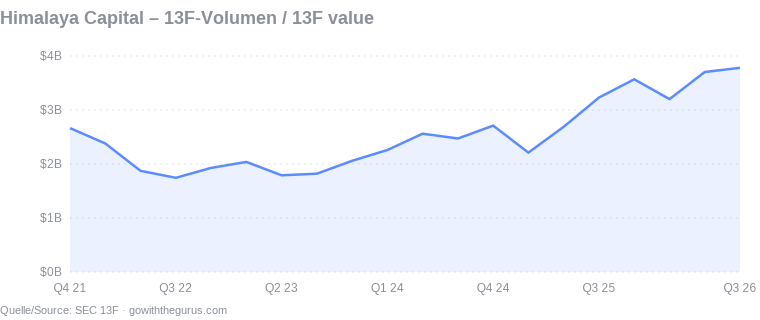
The 13F value reflects this: it moves with share prices, not with hectic repositioning.
The portfolio in Q3 2026
As of 30 September 2026, Himalaya reported eight U.S. positions worth about US$3.78bn – slightly more than the previous quarter (US$3.70bn).
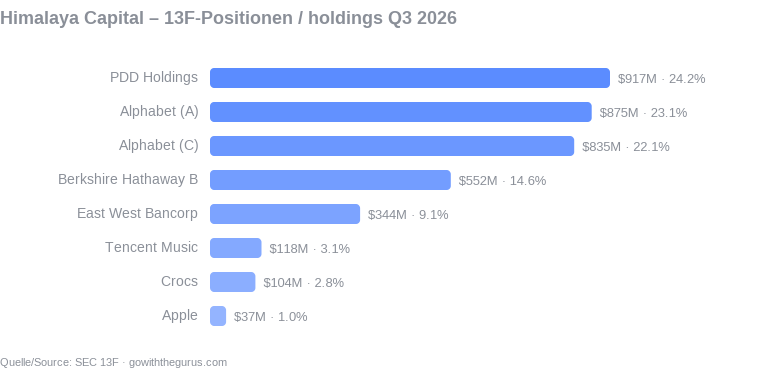
- PDD Holdings – 24.2%. The parent of Temu and Pinduoduo is now the largest single position.
- Alphabet (Class A and C) – 45.2% combined. Almost half the portfolio is Google.
- Berkshire Hathaway – 14.6%. A bet on the Buffett-Munger machine itself.
- East West Bancorp – 9.1%. A U.S. regional bank with strong ties to Asia, held for years.
- Tencent Music – 3.1%, Crocs – 2.8%, Apple – 1.0%.
What changed
Typical for Li Lu: most positions were left untouched during the quarter. There was movement in only two places:
- PDD: share count up about 9% – after Himalaya had already more than doubled the position in Q2.
- Tencent Music: share count up about 125%.
The bigger reshuffle happened over the course of 2026: at the end of 2025 Bank of America was still one of the three big pillars; it was cut sharply in Q1 2026 and no longer appears from Q2. Occidental Petroleum went too. Smaller Q1 positions such as S&P Global, Moody's, MSCI and H&R Block have gone again as well. In short, Li Lu moved capital from a U.S. bank into Chinese growth (PDD, Tencent Music) while leaving the Alphabet core untouched.
Our take
Himalaya is a case study in concentration. Following the fund means watching convictions rather than trades – which is exactly where both its strength and its risk lie. Whether the growing China weighting pays off will only be clear in years; Li Lu, in any case, thinks in decades.
See all positions and the full history on the Himalaya Capital fund page.
Note: 13F filings only show U.S. long positions at quarter-end and are published up to 45 days later. This article is not investment advice.